Canon Ef Zoom Lens for Canon Ef - 24mm-70mm - F/40 Review
Canon EF 24-70mm f/4L IS USM Lens Review

Equally the Canon EF 24-70mm f/4L IS USM Lens hits the streets, Canon has more than 50mm prime lenses in its lineup than it has total frame general purpose zoom lenses – four vs. three. I am omitting from my count the large, heavy EF 28-300mm f/iii.five-5.6L IS USM Superzoom Lens and the very-wide bending EF 17-40mm f/4.0L USM Lens that could both be used every bit a full frame general purpose lens, just 3 lenses in a most-needed lens category is a relatively small number to select from. So, I definitely see opportunity for an additional full frame full general purpose zoom lens in the Canon lineup.

The zoom lenses I am referring to are:
The EF 28-135mm f/3.5-5.6 IS USM Lens that frequents Canon EOS APS-C body kits is a good value at its very attractive toll, but its tired design is ready for an upgrade in my stance. And this lens' total frame corner functioning is decidedly lacking.
I just completed a review of the other announced-in-2012 24-70mm lens – the impressive Catechism EF 24-70mm f/ii.8L II USM Lens. The 24-70 f/2.8 II has an action-stopping, groundwork blurring f/2.8 discontinuity to its reward over the 24-seventy f/4L IS, while the latter holds the size, weight and price advantages in addition to the pregnant low low-cal handholdability advantage of paradigm stabilization (if the subject is motionless). The f/2.viii lens is a better performer optically.
The third lens is the Canon EF 24-105mm f/4L IS USM Lens that has been, at least prior to the 24-70 f/4L IS inflow, my most-used lens since it was introduced. It offers fantabulous paradigm quality, a wide range of focal lengths and image stabilization. The 24-seventy f/4L IS was initially priced significantly higher than the 24-105 L IS and has a shorter range of focal lengths. These two lenses have similar image quality with each winning specific comparisons.
To the 24-70 f/4L IS's advantage are smaller size and lighter weight, but I don't find these differences to be of keen significance. More important to me is that the 24-lxx L has less distortion, especially at 24mm. A strong reward the 24-70 IS has is the very-impressive-for-a-zoom-lens macro capability. A 0.70x maximum magnification from a not-true-macro lens is eye-opening (more later).
I'll make more comparisons throughout this evaluation, but to displace the long-time bestselling 24-105mm lens was going to be a challenge for the 24-70 f/4L IS. A challenge unless the 24-105 L was discontinued, or what actually happened, the prices were minimally equalized or the 24-lxx'south price became lower. Canon does non typically disembalm their discontinuance plans and, still long afterward review fourth dimension, the 24-105 L remains an active production.

From the announcement date, I was very optimistic near the overall prototype quality from this lens. We saw the epitome quality Canon can evangelize with the 24-70 f/ii.8L Two – and I expected similar from this lens. Image quality is what I expected to be this lens' biggest selling point. Mural and travel photographers peculiarly will move over to the 24-lxx L IS from the 24-105 50 IS if they can see sharper details in their images – especially in the corners.
I've probably worn out the general purpose lens term, but ... this focal length range lands squarely into what I consider to exist ideal for that utilise.
Hither are a couple of examples of what this focal length range (FLR) looks like on a full frame DSLR camera:

The 2d set of examples comes from a large academy gymnasium. Sorry, I don't know how the basketball game became lodged in the steel beam at that meridian (but I'd love to know).
The 24-70mm focal length range (FLR) can work excellently for travel, landscape, product, street, still life, portraits ... and a mind-numbing list of other photography uses. I usually take a lens with this covered range with me whenever I'm shooting.
On an ASP-C/one.6x FOVCF sensor format DSLR, the 24-70mm FLR frames like a 38.4-112mm lens on a full frame trunk. The uses for a such-mounted lens are similar, but portraits go favored to landscapes due to the lack of landscape-favoring wider angles of view and proceeds of portrait-favoring narrower angles of view.
While suitable for close range sports and activity, the f/two.8L 2 is the better 24-70mm lens version for this pursuit. The f/4 max discontinuity is medium-fast, simply the f/two.8 aperture lets twice as much light into the camera. That the f/four max discontinuity is fixed over the entire focal length range means that your wide open aperture exposure settings do not change with zooming. I consider this to be a valuable aspect for any zoom lens to take.

The Catechism EF 24-70mm f/4L IS USM Lens receives Canon'due south 4-stop Hybrid Image Stabilization characteristic (the 24-105 Fifty has 3-stop non-Hybrid Image Stabilization).
Panning detection is automatic. If panning is detected, the 24-70 f/iv IS switches off stabilization in the appropriate direction. While this lens auto-senses tripod use, Canon suggests you lot turn off IS when using a tripod – to reduce battery drain (which I find to be very minimal). Exit IS on when shooting from a monopod
With an approaching-1:1 macro reproduction ratio, this lens volition brand skilful apply of the HIS engineering science: "Hybrid IS detects [and corrects] both angular and shift movements when in macro manner." [Catechism] More about this later.
Many have said that image stabilization is non important in wider angle lenses, just for at least for some uses, I strongly disagree. I am frequently shooting with wide angle lenses in situations where a tripod is non practical – and where deep depth of field is important (recollect f/8 or f/11). Add wind, unstable footing, a CP filter, a state of out-of-breathlessness ... IS can fifty-fifty be needed fifty-fifty under full sunlight. Yes, today's DSLRs evangelize incredible prototype quality at high ISO settings, only, blue skies look MUCH better at ISO 100 than at ISO 800 or 1600.
With this lens, at 24mm, I am getting very good paradigm sharpness with .3 second exposures (nigh iii stops of assistance), notwithstanding decent results at .4 seconds (3 one/3 stops) and merely marginal results on average at .5 seconds (3 2/3 stops).
At 70mm, the 24-70's IS is producing very practiced results at 1/6 second exposures (3 2/3 stops) and good results at 1/5 2nd (4 stops). Results are not good on average at ane/iv seconds. Only sometimes i sharp picture is all you need – and with plenty attempts, one sharp picture is accomplishable.
Here is a look at two long handheld exposure examples:

The 24-70's IS arrangement is very nicely implemented with no viewfinder jumping during startup or during panning motility. A soft click is heard when IS starts and again when it ends. A serenity hum tin can so be heard in a tranquillity surround during activation. IS is a great feature that I lament being absent-minded on the 24-seventy f/2.8L Ii.

As usual, we had the 24-70 IS'south MTF chart available at proclamation time. Hither is a look the theoretical comparisons.
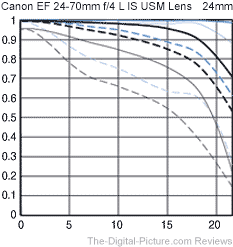
Catechism 24-70mm f/2.8L Two Lens 24mm | 70mm
Catechism 24-70mm f/4L IS Lens 24mm | 70mm
Canon 24-105mm f/4L IS Lens 24mm | 105mm
Catechism 24-70mm f/ii.8L Lens 24mm | 70mm
Canon has been turning out impressively-performing zoom lenses recently and I was quite excited to meet a repeat performance from this lens. Subsequently evaluating iii retail-purchased copies of this lens, here are my observations.
With a wide open up f/iv aperture: At 24mm, the Catechism EF 24-70mm f/4L IS USM Lens is very sharp in the center with adept sharpness extending to the periphery of the full frame prototype circumvolve. This lens gets very slightly softer at 35mm and modestly softer still (especially in the mid and peripheral paradigm circle) at 50mm f/iv where the lens performs its worst. Sharpness comeback by 70mm brings the 24-70 f/4L IS back up to functioning similar to that at 35mm.
Stopping downward to f/5.half-dozen creates a pocket-size improvement in image quality (especially from a noticeable decrease in peripheral shading). Improvement in sharpness is most notable at the long end. Another small sharpness improvement is noticeable in the mid and long focal lengths with an aperture narrowed to f/8. Results remain slightly soft at 50mm.
That this lens performs its worst at a mid-focal length vs. an extremity focal length is unusual. Since most people shoot their highest percentage of images at the focal length range extremes of a lens, the 24-lxx L IS weakness is perhaps well placed. Roger at LensRentals.com has confirmed the 50mm weakness in his vast stock of this lens.
While this lens turns in very proficient image sharpness, I honestly was hoping for astonishing sharpness – and not meeting expectations always causes somewhat of a allow-down for me. I have to keep things in perspective – and this is still a great lens.
If you are shooting at f/11, the 24-70 f/4L IS, 24-105 f/4L IS and 24-seventy f/ii.8L II lenses produce essentially as excellent sharpness.
At 24mm with a broad open aperture, the 24-70 f/4L IS bests the 24-105 L IS in sharpness by a modest amount. The 24-105 L delivers a sharper image at 50mm f/iv. Sharpness improvement at 70mm brings the 24-70 f/4L IS back up to about equality with the 24-105 L. These 2 lenses perform more than similarly at f/5.vi and at f/viii where their results are nearly comparable. Over again, the results are like at f/11.
The Canon EF 24-70mm f/ii.8L II USM Lens is the sharper lens of this group – even at f/2.8 vs. f/4.
Note that the Canon EF 24-70mm f/4L IS USM Lens exhibits some focus shift. Whether it will affect your images or not is questionable. I'll explicate.
Even at MFD (Minimum Focus Distance), the increasing depth of field easily covers the focus shift at 24mm, though subjects in front of the point of focus do non come into focus as quickly as background objects do. Even so, this is not the case by 70mm MFD where the point of focus goes slightly out of focus at midrange apertures every bit demonstrated beneath (33% resolution shown). The f/4 image will show the betoken of sharp focus. Watch how the depth of field changes as the lens is stopped downward to a narrower aperture.

Motion the 70mm subject out to about 3' (1m) and DOF in one case once more covers the focus shift as demonstrated below (100% resolution shown). Once again, find a indicate of sharp focus in the f/4 paradigm and watch how it changes as the discontinuity narrows.

The focus shift is still present in the example above, but the point of focus does not get less sharp. With the macro adequacy this lens has (and the rather soft image quality at 70mm MFD with wide apertures), I suggest fugitive utilize of 70mm at the MFD. Shift into the specialized macro mode for these needs.
I'll talk more about macro mode afterward, but to use this mode but requires rotating the zoom band across the 70mm focal length via a switch. There is a range of zoom ring rotation designated for macro use with a significant subset designated as the suggested range. Some focus shift remains in the wider angle rotation portion of the macro mode, merely the shift clears upwards in the mid and longer suggested range. There may even be a slight focus shift forward at the furthest recommended rotation setting as demonstrated below (33% resolution shown). Use the left-most "1" equally a point of sharp focus reference.

Don't use the above samples for image quality evaluation as the quality of the sheet music printing is not good, the lighting was not critically controlled and many of the results are reduced.
You will come across very low distortion from the 24-seventy f/4L IS relative to similar zoom lenses. Expect to see light-merely-noticeable butt distortion at 24mm. This lens is almost baloney-free at 35mm and shows mild pincushion distortion over the longer end of the FLR.
The 24-70 f/4L IS shows less baloney than the 24-105 f/4L IS – and significantly less at 24mm. Landscape photographers shooting over a flat horizon (such every bit water) will specially appreciate the difference at their near-frequently-used focal length: 24mm. Having a distortion-free lens makes leveling the framed scene much easier and reduces the subversive distortion correction needed during post processing.
There will exist a minor amount of CA (Chromatic Aberration) in the peripheral image circle at 24mm, but the 24-seventy f/4L IS is nearly void of CA until the longer end of the focal length range where mild CA becomes apparent at 70mm. The 24-seventy f/4L IS has noticeably less CA than the 24-105 f/4L IS at the wide end, just more than at 70mm.
The 24-70 f/4L IS is similar to the 24-70 f/ii.8L Ii in regards to both CA and baloney.
Full frame format DSLR images will see virtually two.v stops of f/4 peripheral shading at 24mm, i.four stops at 35mm, 2 stops at 50mm and 2.5 stops once more at 70mm. By f/5.six, much of the vignetting is gone, though virtually 2 stops remain in 24mm corners and a merely-noticeable 1-cease remains at 70mm. Piffling change is noticed by stopping downwardly to f/viii or f/11.
The 24-lxx f/4L IS has less vignetting than the 24-105 f/4L IS at the broad end at f/iv, but more at the long end. By f/v.six, the ii lenses are close in this regard. The 24-70 f/2.8L Two, with its 1-cease wider aperture, has the comparable-aperture vignetting reward until about f/viii where the two are nearly equal.
This lens features Super Spectra coatings to reduce flare and increase contrast. While the increased contrast part appears successful, I'chiliad non as amazed with the flare performance from this lens. Y'all will desire to avoid the sun in the frame at all focal lengths and apertures – unless you lot want the artistic effects of flare. The 24-105 L and 24-70 L II show slightly less flare, but non enough less to be a differentiating factor.
While a 24-70mm f/iv lens is not going to be considered astonishing for its groundwork blur cosmos capabilities, information technology tin create blurred backgrounds – and the quality background mistiness (bokeh) created by this lens and its circular 9-bract aperture is very aesthetically pleasing. Here is a 70mm f/eight instance that specifically shows how specular highlights are treated.

Canon has again used a fluorine coating on the exterior surfaces of this lens. This coating makes the exposed lens elements much easier to clean – peculiarly in the field.

While an f/4 max aperture lens will not calorie-free upwardly the highest precision autofocus capabilities of some Canon DSLR cameras, the Canon EF 24-70mm f/4L IS USM Lens withal performs very well (and very fast) with Band USM driving its AF organization. The divergence in focusing speed between this lens and the 24-105 Fifty is ephemeral to me. The 24-lxx 50 Two appears to focus slightly faster, but this is even so not piece of cake to discern.
AF accurateness from this lens has been very skillful – performing well even in AI Servo fashion. This lens focuses very quietly with a light "shhhh" heard during autofocusing.
The 24-70 f/4 IS L does non extend with AF and FTM (Full Time Manual) focusing is bachelor (no switch change is required to manual focus after autofocusing). Filters practise non rotate during autofocusing.
A shine, well-damped, nicely-sized manual focus ring with practically no play and a nice amount of rotation (108°) available makes fine focusing piece of cake. I appreciate the frontwards position of the transmission focus band with the zoom band to the rear, where my supporting hand rests.
The 24-lxx f/4L IS exhibits some focus breathing (subjects alter size with focus altitude change), but the corporeality of size change is not drastic.

In the 24-70mm f/2.8L II review, I lamented near the loss of maximum magnification (MM) from the preceding Canon EF 24-70mm f/2.8L USM Lens. No lamenting this time. The 24-70 f/4L IS' maximum reproduction ratio blows abroad all Canon non-truthful-macro lenses before it.
Within the normal focal length range settings, this lens has a adept, merely not unusual, MM of 0.21x at a minimum focus distance of fifteen" (380mm). This means that a subject area tin exist reproduced at 0.21 times its real life size onto a sensor. A 100mm subject tin exist made to cover 21mm of a sensor (which of course looks huge on your monitor).

By pushing a jump-loaded switch (shown above), the zoom ring is able to motility into (and lock inside) a range of macro focal lengths. The lens extends slightly as information technology transitions into the macro range, but settles dorsum to shorter-than-70mm physical length by ~80mm as shown below.

These focal lengths are not actually longer than 70mm, though some cameras (including the 1D X) volition written report focal lengths of upward to 80mm. From the zoom ring action, information technology would seem as though the lens is being adjusted to a longer focal length. When zooming within the macro-restricted range, the lens acts like it has a variable length extension tube installed. As the zoom band is moved from the 70mm side of the macro setting to the ~80mm side, the lens focuses on subjects closer to the lens – merely the maximum focus distance is reduced. The focus ring notwithstanding provides a range of focusing within each ~focal length setting.
As the lens is zoomed to ~80mm (once more, not really 80mm), minimum focusing distance reduces to 7.87" (200mm). Since MFD is measured from the imaging sensor aeroplane, the working distance (WD) is considerably less. At 7.87" (200mm), there is about 1.2" (30mm) of WD remaining betwixt the front lens element and the field of study. Forget using the lens hood – it is longer than the WD – and lighting within the minor opening between the lens and the subject becomes a claiming.

Minimum image degradation occurs when a focus distance setting within a yellowish line on the focus altitude calibration is used (partially visible in the to a higher place picture). This setting range is from about three' to v+' (0.viii-1.5m) (notation that these are not actual focus distances in macro mode). You can achieve a magnification of about 0.5x at the minimum recommended focus altitude at ~80mm – with a working distance of just nether 2.five" (64mm). Allow'southward await at some examples.
The Canon 1D X-captured subject below is an American Hawkeye Silverish Dollar proof money measuring 1.597" (40.5mm). Lighting is from a Catechism 600EX-RT Wink, Canon ST-E3-RT and a softbox mounted on a backlight stand up.

The 0.21x magnification is average for a zoom lens – and is the MM for this lens in the normal focal length range setting. Magnification in macro mode is based on zoom band position, focus ring position and subject altitude. The center 2 examples show the range of magnifications available inside the recommended (for optimal image quality) focus distance range at ~80mm. The 0.70x case shows absolute MM.
Just because a lens has a macro feature doesn't mean that you will actually want to use it – especially if the prototype quality does non satisfy. Non a trouble in this instance. Let'south look at some plumage item on a Blueish Jay.
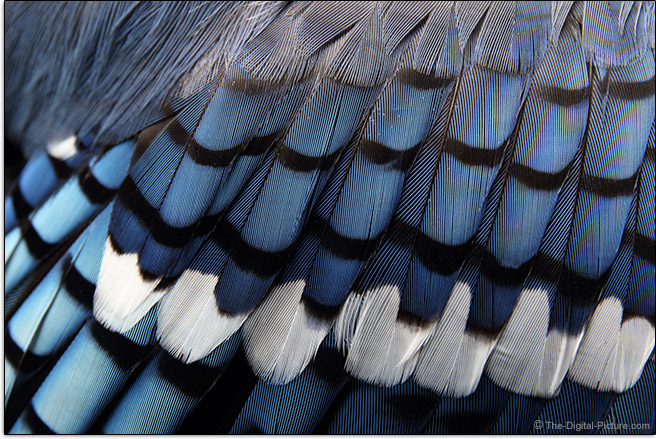
The above images were captured with a 1D 10 set to f/xi to become as much DOF as possible (DOF becomes very shallow at these short focus distances). A DPP sharpness setting of "2" (very low) was used to process the raw images. In the total paradigm, you can tell that I'thousand struggling to evenly lite the wing. A macro ring lite would accept been a good pick in this case.
Fifty-fifty outside of the recommended focus distance, the 0.7x ingather is sharp – and has expert sharpness right into the frame edge. Moving slightly further away gives us the approximately 0.5x crop with slightly amend sharpness – and more DOF.
I'm non going to say that this lens is every bit sharp equally the Canon 100mm L Macro Lens, but the Catechism 24-seventy f/4L IS Lens' macro mode is very impressive. This lens could easily readapt a macro lens in your pack – which in turn makes the size and weight departure of what you are carrying large.
HIS is activated in Macro fashion, but IS is less effective at closer distances. Catechism has used between 1 and 2 stops as the reduced affectivity figure and also has stated IS effectiveness to be 3 steps at 0.5x and two.v steps at 0.7x. IS definitely makes handheld framing of close subjects easier.
The camera's AF and AE work fine in macro mode, just the effective max discontinuity is reduced at shut focusing distances (this is normal). Here is a table of the effective max aperture reduction:
| Magnification | one:5 | 1:iii | 1:two | 1:ane.15 |
| Constructive Max f/No. | 4.71 | v.06 | 5.66 | 5.66 |
| one/3 Exposure Stops | +1/3 | +2/3 | +1 | +1 |
| ane/2 Exposure Stops | +1/ii | +1/two | +one | +one |
While the 24-seventy f/4 IS is nevertheless compatible with extension tubes, I don't know why you lot would employ them. With a 12mm Extension Tube in place, the non-macro-mode maximum magnification spec goes to 0.44-0.18x. The 25mm Extension Tube takes the spec to 0.72-0.40x. Interesting that 25mm of extension results in a 0.72x max magnification while the built-in macro features a 0.7x spec.
Extension tubes shift the lens farther from the camera mount. When looking in the rear of the 24-70 Fifty IS as information technology is shifted into macro manner, the rear element does retract into the lens by increasing amounts up to ~80mm. The total retraction distance is well-nigh 0.5" – or 12.7mm. This is obviously non 25mm, and then additional lens element activeness is being used to accomplish this magnification feat.
Following is a comparison table showing the MFD and MM of many Catechism lenses.
| Model | MFD | MM | |
| Catechism EF-S 15-85mm f/3.v-5.6 IS USM Lens | 13.8" | (350mm) | 0.21x |
| Catechism EF 16-35mm f/2.8L Two USM Lens | 11.0" | (280mm) | 0.22x |
| Canon EF 17-40mm f/4.0L USM Lens | 11.0" | (280mm) | 0.25x |
| Catechism EF-S 17-55mm f/ii.8 IS USM Lens | 13.8" | (350mm) | 0.16x |
| Canon EF-S 18-55mm f/iii.5-v.half dozen IS Two Lens | 9.viii" | (250mm) | 0.34x |
| Catechism EF-S 18-135mm f/iii.5-five.6 IS STM Lens | 15.four" | (390mm) | 0.28x |
| Canon EF-Southward 18-200mm f/3.v-five.6 IS Lens | 17.7" | (450mm) | 0.24x |
| Canon EF 24-70mm f/2.8L 2 USM Lens | fifteen.0" | (380mm) | 0.21x |
| Canon EF 24-70mm f/4L IS USM Lens | 7.ix" | (200mm) | 0.70x |
| Catechism EF 24-105mm f/4L IS USM Lens | 17.7" | (450mm) | 0.23x |
| Catechism EF 28-70mm f/2.8L USM Lens | 19.seven" | (500mm) | 0.18x |
| Canon EF 28-135mm f/3.5-5.6 IS USM Lens | nineteen.vii" | (500mm) | 0.19x |
| Canon EF 28-300mm f/3.5-five.6L IS USM Lens | 27.6" | (700mm) | .030x |
Nothing is shut. The MM spec alone will sell a lot of Canon EF 24-70mm f/4L IS USM Lenses. Equally usual for standard zoom lenses, this lens is not compatible with Canon Extenders.

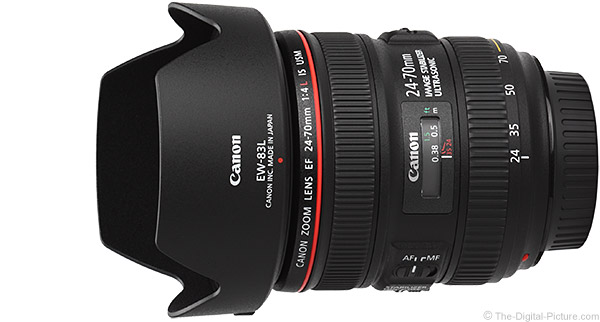
Like most standard zoom lenses, the 24-70 f/4 IS extends equally focal length is increased – by i.21" (30.8mm), which is 0.02" (.5mm) less than the 24-lxx f/two.8L 2 extension amount.
Like all Catechism Fifty Lenses, the 24-70 f/4L IS is congenital for professional apply with quality construction. Fit is tight and cease is tops. This lens looks slap-up, has a bully feel and has solid build quality. Based on an engineering plastic barrel, the extension, zoom rings and the rest of the lens are solid with practically no play.
The zoom ring is nicely damped with a very slight slip-stick characteristic that I look will go away with intermission-in. Gravity zooming (lens extends past itself when pointed downwards) is not an issue, but a lock switch (combined with the macro switch) enables the lens to exist locked at 24mm.
This is a atmospheric condition-sealed lens, though I propose using a protective front filter to insure no moisture enters around the front element.
The size and weight of the Canon EF 24-70mm f/4L IS USM Lens are such that this lens is very easy to carry and use – fifty-fifty for long periods of time.
Equally I said in the beginning of this review, the weight and size of this lens are nicely less than the 24-70mm f/2.8L Ii Lens. The f/iv weighs about 75% of the f/2.8's weight. Much closer in size and weight are the 24-70 f/4L IS and the 24-105 f/4L IS lenses. Hither is a comparison table:
| Model | Weight | Dimensions w/o Hood | Filter | Year | ||
| Canon EF-S fifteen-85mm f/three.five-5.half dozen IS USM Lens | 20.3 oz | (575g) | 3.2 10 three.4" | (81.six 10 87.5mm) | 72mm | 2009 |
| Canon EF 16-35mm f/2.8L Two USM Lens | 22.half dozen oz | (640g) | iii.5 x four.four" | (88.5 x 111.6mm) | 82mm | 2007 |
| Catechism EF 17-40mm f/four.0L USM Lens | 16.8 oz | (475g) | 3.three x 3.viii" | (84 x 97mm) | 77mm | 2003 |
| Canon EF-S 17-55mm f/2.8 IS USM Lens | 22.8 oz | (645g) | 3.3 x four.4" | (83.five ten 110.6mm) | 77mm | 2006 |
| Catechism EF-Due south 18-55mm f/three.5-5.6 IS Two Lens | 7.1 oz | (200g) | 2.7 x 3.3" | (68.5 x 84.5mm) | 58mm | 2011 |
| Canon EF-Due south 18-135mm f/3.5-5.6 IS STM Lens | 16.9 oz | (480g) | 3 x 3.8" | (76.vi x 96mm) | 67mm | 2012 |
| Canon EF-S 18-200mm f/iii.v-5.6 IS Lens | 21.0 oz | (595g) | iii.1 ten 4" | (78.six ten 102mm) | 72mm | 2008 |
| Canon EF 24-70mm f/2.8L Two USM Lens | 28.4 oz | (805g) | three.5 x 4.4" | (88.5 10 113mm) | 82mm | 2012 |
| Catechism EF 24-70mm f/4L IS USM Lens | 21.2 oz | (600g) | three.3 ten 3.vii" | (83.iv x 93mm) | 77mm | 2012 |
| Canon EF 24-105mm f/4L IS USM Lens | 23.vii oz | (670g) | 3.three ten four.2" | (83.5 x 107mm) | 77mm | 2005 |
| Canon EF 28-135mm f/three.5-5.vi IS USM Lens | 19.i oz | (540g) | iii.one x iii.8" | (78 x 97mm) | 72mm | 1998 |
| Canon EF 28-300mm f/3.v-v.6L IS USM Lens | 59.0 oz | (1670g) | 3.6 x vii.half dozen" | (92 10 194mm) | 77mm | 2004 |
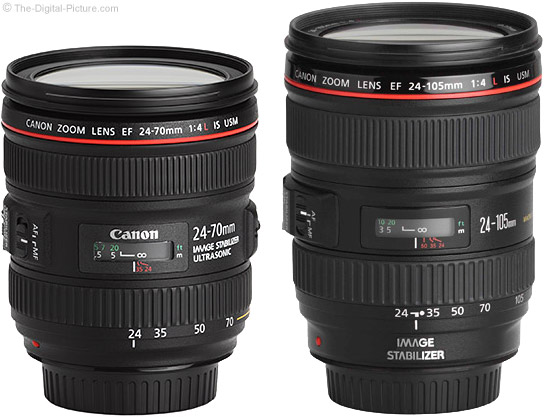
For many more comparisons, see the complete Canon EF 24-70mm f/4L IS USM Lens Specifications using the site'southward Lens Spec tool. Here is a visual comparison of a subset of the above lenses.

Positioned higher up from left to correct in their fully retracted positions are the following lenses:
Canon EF 28-135mm f/3.5-v.6 IS USM Lens
Catechism EF 24-70mm f/4L IS USM Lens
Canon EF 24-105mm f/4L IS USM Lens
Canon EF 24-70mm f/2.8L II USM Lens
The aforementioned lenses are shown below in their fully extended states with their lens hoods in place.

I've been complaining about Canon's old side-pinch-just lens caps for a very long time. It is so refreshing to become the fantabulous new Canon Lens Cap II as shown below. This cap is easy to remove within of the installed lens hood.

The 77mm filter size has long been a standard for Canon L zoom lenses. While the EF 24-70mm f/2.8L II veered from this standard, the 24-70 f/4L IS in one case again assumes it. In that location is benefit to lenses sharing a like filter size, though I usually want a filter for each lens anyway (saves the filter modify time in the field). A standard 77mm circular polarizer filter volition add together a slight amount of vignetting at 24mm. I recommend a B+West 77mm HTC XS-Pro CP filter for this lens (what I'm using).
The 24-70 f/iv IS comes with a EW-83L lens hood and an LP1219 depict-string pouch included.

Let's sidetrack momentarily with a spelling lesson. "Canon" is a visitor that makes imaging equipment including the cameras and lenses we honey. "Cannon" is the proper noun of a war machine weapon. If yous are searching for a camera, yous desire a Catechism. If you are participating in a war, or a state of war re-enactment, yous want a Cannon. In this case, the cannon has been shot with a Canon:

Getting a photo of a cannon in Valley Forge National Historical park is easy. Getting a warm light on the cannon simply ways timing your photo with a belatedly twenty-four hour period dominicus (or early day sun depending on which cannon you lot are shooting). Having a little cloud that looks similar fume coming from the cannon come by at the right time? Priceless.
Which Catechism yous shoot your cannon with is another question. The Catechism EF 24-70mm f/4L IS USM Lens worked nifty for my brusk trip to this park (and of course in many other closer-to-domicile uses I've found for it). I was shooting in high winds with very common cold temperatures. I used a tripod at times, merely run-and-gun way shooting using IS immune me a significantly greater take-domicile than I would have otherwise had.
I see the primary alternative to the 24-lxx f/4L IS beingness the Canon EF 24-105mm f/4L IS USM Lens. Deciding betwixt these two lenses was a challenge for me. I shared my thoughts in this page: Should I go the Canon EF 24-70mm or 24-105mm f/4L IS Lens? As I shared on that page, I decided that the 24-lxx f/4L IS was the right pick for me and have been very pleased with its operation. I have used this lens from the four corners of the USA and many locations between them.

With the introduction of the Canon EF 24-70mm f/4L IS USM Lens, Canon's full frame general purpose lens category has another great option and that option is a great one.
Bringing you this site is my full-time job (typically 60-80 hours per calendar week). Thus, I depend solely on the commissions received from yous using the links on this site to brand whatsoever purchase. I am grateful for your support! - Bryan
My Recommended Canon EF 24-70mm f/4L IS USM Lens Retailers
Rent the Canon EF 24-70mm f/4L IS USM Lens
The Tip Jar
More than Catechism EF 24-70mm f/4L IS USM Lens Related Information
Bryan Recommends Ownership It Here
Source: https://www.the-digital-picture.com/Reviews/Canon-EF-24-70mm-f-4-L-IS-USM-Lens-Review.aspx
0 Response to "Canon Ef Zoom Lens for Canon Ef - 24mm-70mm - F/40 Review"
Post a Comment